
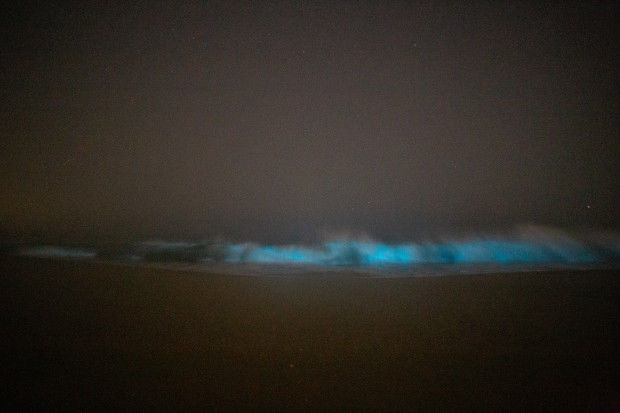
A rare phenomenon called bioluminescence created an explosion of neon blue in waves crashing onto shore in Newport Beach, a moment caught on camera by a trio of Southern California photographers who scouted out the extraordinary sight in the darkness late Wednesday evening, April 15.
It’s a sight not documented off local waters in years.
“The first two times I documented it, it was amazing, but it wasn’t that bright,” said photographer Patrick Coyne, who drove from Torrance to take video of the bioluminescence in Newport Beach.
He’s seen the phenomenon twice before in Malibu, but said Wednesday’s show in Newport was the best he’s witnessed.
“As soon as the set crashes, it’s a burst of blue light. It’s not always the perfect burst of blue light, you want it to be dark,” he said. “Once it hits, it’s a burst of blue light and you get that color. And it really does look like what you see in pictures and videos.”
What is dinoflagellate bioluminescence?
The Scripps Institution of Oceanography explains how this beautiful phenomenon happens.
In coastal regions, the primary source of flow-agitated bioluminescence is dinoflagellates. These single-celled organisms are common members of the plankton—tiny marine plants, animals or bacteria that float on or near the ocean’s surface.
Bioluminescent dinoflagellates range in size from about 30 µm to 1 mm, and are found in all the world’s oceans.
Occasionally they are found in high concentrations, resulting in red tides, so called because the high abundance of organisms discolors the water. If the dinoflagellates are luminescent, there can be spectacular displays of bioluminescence at night.
For example, in October 2011 there was an intense red tide of the dinoflagellate Lingulodinium polyedrum in San Diego.
How cool is that?
